Ant bait, kids and pets
Keep baits and sprays out of reach. If someone swallows one, contact the National Poisons Centre on 0800 764 766 immediately, and don't make them throw up unless you're told to. If they're unconscious, having trouble breathing or look very ill, phone 111. If a pet gets into bait, ring your vet now.
Is it an Argentine ant?
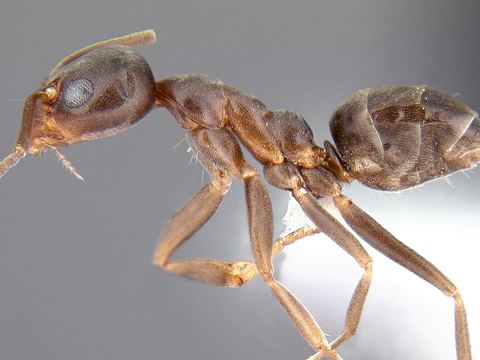
Start with colour. DOC says Argentine ants are honey-brown and 2 to 3 mm long, and that most other ants seen in New Zealand are black.
Then watch how they move. DOC describes trails of five or more ants wide, packed close together. Manaaki Whenua says they walk steadily in continuous lines, often up trees and shrubs, especially flowering ones.
Argentine ant or another kind?
| Argentine ant | Most other ants here | |
|---|---|---|
| Colour | Uniform honey-brown | Black, says DOC |
| Trail | Wide, busy and continuous | Usually a thinner line |
| If crushed | A slight greasy smell | Some give a strong formic acid smell |
| Sting or bite | Can't sting, though some people react to the bite | Depends on the species |
What about the other ants?
We haven't read a New Zealand source that sorts household ants by species, so we won't guess at names from a description. A clear close-up photo is more use to a technician than anything we could tell you here.
Where are Argentine ants found?
They were first recorded in Auckland in 1990. DOC now lists many parts of Auckland, Northland, Waikato, Bay of Plenty and Hawke's Bay, plus Wellington, Nelson and Christchurch. Manaaki Whenua says they rank highly as a household nuisance, getting into cupboards, sealed jars, electrical areas and behind walls and beds.
Regional rules can touch them too. Under Auckland's pest plan they're under sustained control across the region, and Northland's rules cover moving material that may carry them.
Why can a spray make it worse?
Because a colony isn't one nest. Manaaki Whenua says Argentine ant colonies have many queens, and separate nests can link up into supercolonies. DOC says the wrong amount of pesticide could lead a colony to separate, which makes the ants harder to control.
Northland Regional Council says to get advice before trying DIY control, because a failed attempt can cause bait aversion (ants learning to leave the bait alone) or spread them further. It also says bait doesn't work well in the colder months.
How to get rid of ants
Get a clear photo first
Do this before you wipe anything away. The trail shows where they're going, and that's the useful part.
Take away the food
Wipe benches, put sweet things in sealed containers, and lift pet bowls at night.
Follow them back
Trace the line outside if you can. A trail up a tree or along a fence tells you far more than a few ants on the bench.
Seal the gaps they use
Fill small gaps around pipes, window frames and skirting where the line comes in.
Check what you're bringing in
DOC says potted plants carry the highest risk of spreading Argentine ants. Garden soil, bark and building materials can carry them too.
Match the next step to the ant
A few black ants may end there. Honey-brown ants in wide trails are worth a pest business, before anyone starts spraying.
Yours, and a technician's
You can
- Keep the kitchen clean and food sealed.
- Seal gaps and trim branches touching the house.
- Keep potted plants checked before they come home.
Leave to a pest business
- Identifying the ant and finding the nests.
- Planning bait or treatment for the season.
- Treating outdoors as well as in.
What to ask before you say yes
- Which ant do you think this is, and how can you tell?
- Will you treat outside as well as inside?
- Which product will you use, what's its full name, and can I have the safety data sheet?
- Should my neighbours be involved?
- What results should I expect, and when?

What we'd actually do
We'd leave the can in the cupboard until we knew which ant it was. Black ants on the bench usually call for a clean-up and a tube of sealant. Honey-brown ants pouring along the fence line are worth getting someone in for, and we'd have a word over the fence too, because yours may not be the only place they're living.
Want someone to look at it?
Tell us what you've seen and your postcode, and a local pest business that handles exactly that calls you to talk it through.