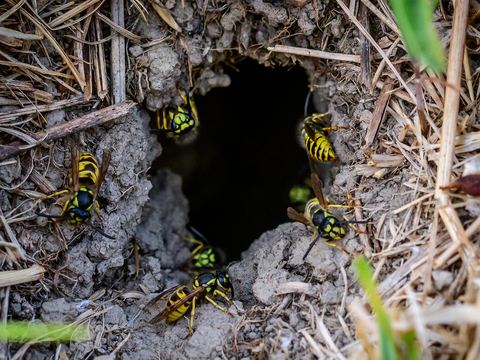
Nest close by? Do this first
Get people and pets away, and don't poke, block or spray it. Trouble breathing, wheezing or swelling around the lips and eyes after a sting needs 111. Otherwise wash the sting with soap and cold water and hold ice on it for 15 minutes, as Health NZ advises. The National Poisons Centre is on 0800 764 766 for first aid advice.
Which wasp nest is it?
| German wasp | Common wasp | Paper wasp | |
|---|---|---|---|
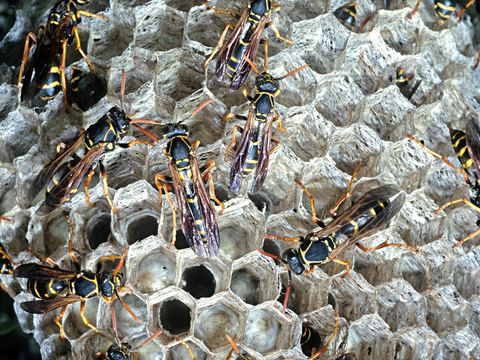
| Nest looks | Grey and enclosed | Brown and enclosed | Open comb, about pear sized |
| Nest is usually | In the ground or a cavity | In the ground or a cavity | Hanging under eaves or branches |
| Colony | Soccer ball size or bigger | Soccer ball size or bigger | Small |
| Arrived here | 1940s | Late 1970s | Asian paper wasp, late 1970s |
Is it actually wasps?
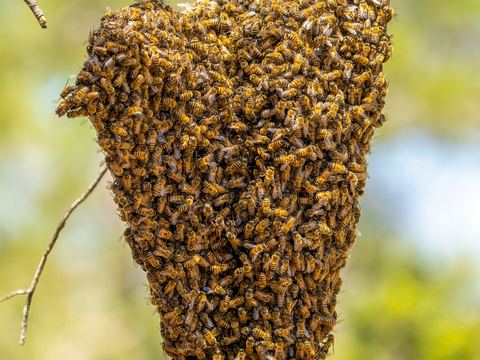
Check before you ring anyone. Fuzzy bees going in and out of a wall or roof are a different job, and a clump of bees hanging from a branch is a swarm, which goes to a beekeeper. Our pages on bees and bee swarms cover both.
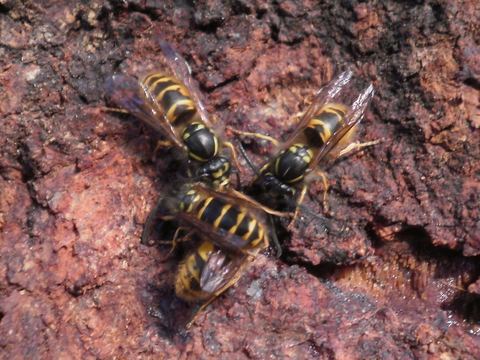
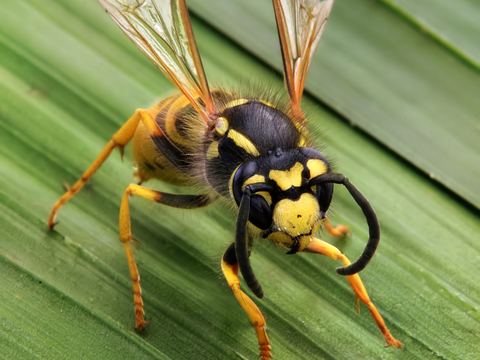
Wasps look smooth and shiny, with a clear waist. New Zealand has four you're likely to meet: the German, common, Asian paper and Australian paper wasps. DOC says German and common wasps are very similar, so the nest is your clue. Our guides to the German wasp and paper wasp go further.
What about the common wasp?
Despite the name, it's the later arrival. DOC says it turned up in the late 1970s and is now widespread. Its brown nest is the difference you can see. In some beech forests, DOC estimates about 12 nests, or 10,000 worker wasps, per hectare in season.
How to get rid of a wasp nest
Keep everyone clear
Close nearby windows and move kids, pets and outdoor meals somewhere else.
Work out where it is
Watch the flight line from well back. Note whether it leads to the ground, a wall, a roof or a tree.
Check whose land it is on
A nest on council land or a reserve is a call to your council. On private land it's usually the owner's or occupier's job.
Get a pest business to treat it
Never spray or block a nest yourself. A wasp nest in a wall or ceiling can send wasps inside the house if the entrance gets shut.
Ask what happens afterwards
Find out how long to stay clear, and whether the nest stays in place or comes out.
Will the council deal with it?
Generally only on public land. Porirua City Council asks people to report nests in public places, and says owners are responsible on private property. New Plymouth District Council doesn't manage nests on private property either, but wants to hear about nests in parks and reserves. In the Waikato region, problem nests on council reserves and accessways go to that district or city council.
Queenstown Lakes District Council destroys nests on council land as part of its pest work. Greater Wellington's pest plan puts wasps under sustained control across the Wellington region. So it's worth a quick look at your own council's pages.
Can I buy wasp bait?
Not the one you've probably heard of. DOC says Vespex wasp bait can only be bought by approved users, who must pass an online test, and that it works only in warmer months when wasps are eating protein. It's a tool for landscape programmes, not a backyard fix.
What to ask the pest business
- Can you tell which wasp it is from my photo?
- Is the nest on my land, or the neighbour's?
- What's the product called, and how long should we stay away?
- Will you need to get into the ceiling or a wall?
- What should we do if we still see wasps after a few days?

Our take on wasps and wasp nests
Take the photo, not the risk. A nest near a door, deck or path is worth sorting this week, and one at the far end of the section can usually be planned around. Either way, it's somebody else's ladder. Tell us where it is and how close it is to where people walk.
Want someone to look at it?
Tell us what you've seen and your postcode, and a local pest business that handles exactly that calls you to talk it through.