Seen mud instead of dust?
Borer leaves dust. Mud packed into gaps in timber, or mud tunnels running up a wall, is something else: MPI lists those as signs of termites. Don't disturb it, and call MPI. That call doesn't go to a pest business.
What does borer look like?
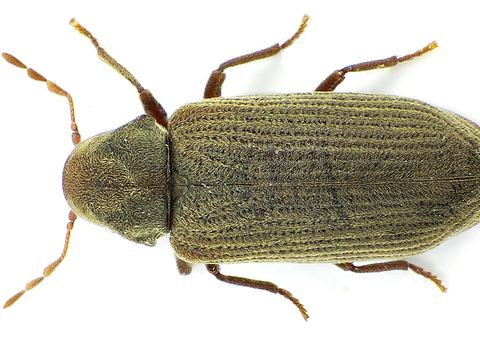
You'll probably see the holes long before the insect. Settled.govt.nz, the government's home buying guide, calls borer small brown beetles. The common furniture beetle, the usual house borer, is about 4 mm long and chocolate brown, with its head tucked under its thorax.
The larva is a greyish white grub with a gold-brown head, and it stays out of sight inside the wood. Auckland Museum says that's the stage doing the boring, and the holes and tunnels it leaves weaken the timber.
Signs in the timber
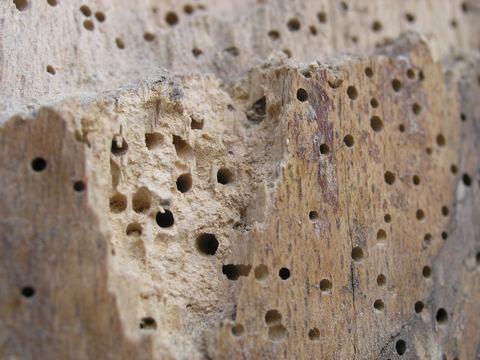
- Round or oval holes in the wood.
- Borer dust sitting below the holes.
- Weak or creaking floorboards with crumbling corners and edges.
- Tunnels in the wood, if you can see into it.
- Small brown beetles near holes or on windowsills in summer.
Is it borer or something else?
| Borer | Two-toothed longhorn | Possible termites | |
|---|---|---|---|
| What you see | Small holes, fine dust | Larger, more oval holes | Mud in gaps, mud tunnels |
| Hole size (Consumer NZ, 2015) | 2 to 4 mm | Up to 7 mm | Not about holes |
| Who to call | A pest business | A pest business | MPI |
Is it still active?
Holes alone won't tell you. A hole is only where a beetle left, and the larvae spend 2 to 4 years feeding before that happens, so an old house can hold plenty of finished ones.
Fresh, loose dust under a hole is the sign to take seriously, and so are beetles around the timber in summer. Wipe the dust away and look again a few weeks later. If it's back, something's still working.
Where should you look first?
Settled lists floorboards, timber piles (the short posts that hold up a timber floor), weatherboards and furniture. Consumer NZ said in 2015 that borer prefer seasoned or moist untreated timber, and often turn up on the south side of a building or in floor timbers prone to damp.
So start low, and start on the shady side.
How serious is it?
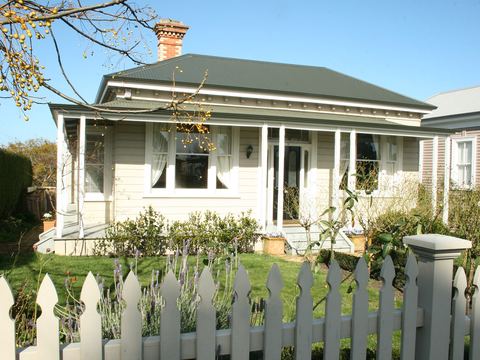
Usually slow, sometimes structural. Settled warns that timber framing grows more open to borer as it ages, and that a home's structure can suffer. Holes in a bookcase are a furniture problem. Holes in a pile are a house problem.
Buying an older place? Ask that the building inspection covers borer, because Settled says some inspectors exclude liability for it.
Before anyone comes out
You can
- Check floorboards, skirting and furniture with a torch.
- Take close photos with a coin in the shot.
- Clear the dust from one patch so you can see if it returns.
- Keep the space under the floor aired and dry.
Leave to a pest business
- Getting under the floor to check piles and bearers.
- Deciding what can be treated and what should be replaced.
- Any treatment of the timber itself.

Our take on borer
A few old holes in an old house aren't a crisis. Fresh dust, soft boards or holes in the piles are a different story, and we'd want someone under the floor with a torch. Send through a couple of photos and where you found it, and read our page on borer treatment before you agree to anything.
Want someone to look at it?
Tell us what you've seen and your postcode, and a local pest business that handles exactly that calls you to talk it through.