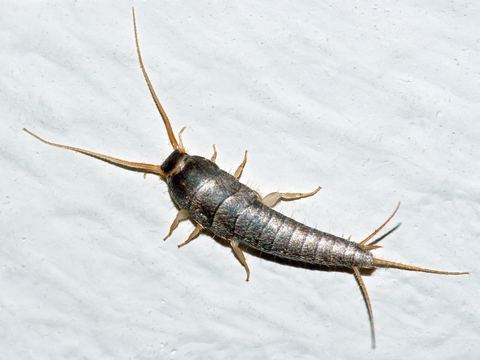
How to tell it's a silverfish
A grown silverfish is silvery grey and about 15 mm long, with a body that tapers towards the tail like a teardrop. It has no wings, six short legs, long thread-like antennae and three thread-like tails at the back.
It's mostly out at night, and it freezes or bolts for cover when you lift a box or flick on a light. That's why plenty of people only ever see one in the bath, or find the damage first.
Silverfish or something else?
| Silverfish | Bristletail | Booklouse | |
|---|---|---|---|
| Size | About 15 mm when grown | Similar look | 1 to 2 mm |
| Tails | Three, of similar length | Middle tail much longer | None |
| Moves by | Running, sometimes a hop | Jumping when disturbed | Creeping slowly |
| What stands out | Silvery scales, teardrop shape | Large eyes that touch | Tiny, soft and pale brown |
Why do they like your house?
Damp and starch. Auckland Museum says silverfish like cool, damp conditions and eat paper starch, which is why they're drawn to its documentary heritage collections. Your version of that is the box of old papers in the garage, or the bookshelf against an outside wall.
The museum also points out that many parts of Aotearoa have high humidity, over 65%. Bathrooms, laundries, ceiling spaces and subfloors (the space under a raised floor) can all stay damp enough to suit them.
Does a silverfish do any harm?
Not to you. They don't sting, and we've found no New Zealand health source treating them as a risk to people.
The damage is to things. Indoors they graze on surfaces, including wallpaper glue, book bindings, photographs, paper and cotton. Auckland Museum lists them among the pests that eat collections, so family papers and photos are what we'd protect first.
They've had a long time to get good at this. The museum says their insect group has been around for more than 400 million years.
What usually sorts it out
You can
- Fix drips, and run the fan or open a window after showers.
- Move papers and photos out of basements and bathrooms, off the floor and away from outside walls.
- Swap cardboard boxes for sealed plastic tubs.
- Check stored papers regularly, the way the museum checks its own.
- Use a moisture absorber in a small closed space. The museum suggests keeping humidity below 60%.
Leave to a pest business
- A general treatment if numbers stay high once the room has dried out.
- Tracking down where they're coming from if you can't find it.

Where we'd start with the silverfish
One silverfish in the bath isn't worth paying anyone for. We'd dry the room, move the paper and watch for a few weeks. If they keep turning up, or you're finding damage on books or photos you care about, tap Not sure what it is and say what you've seen.
Want someone to look at it?
Tell us what you've seen and your postcode, and a local pest business that handles exactly that calls you to talk it through.