Think it might be a brown marmorated stink bug?
Keep it alive. Catch it, take a photo, and report it to the Biosecurity New Zealand hotline. This goes to Biosecurity New Zealand, not to a pest business.
How do you spot one?
Kiwifruit Vine Health (KVH), the kiwifruit industry's biosecurity body, gives three things to check on an adult. It's 14 to 17 mm long, roughly a 10 cent coin. It has white banding on the antennae. And it has alternating black and white markings on the abdomen.
The body is a mottled brown shield. Size alone won't settle it, because a brown form of the green vegetable bug can run just as big. Look for the white bands.
Which stink bug have you got?
| Brown marmorated stink bug | Brown shield bug | Green vegetable bug | |
|---|---|---|---|
| Length | 14 to 17 mm | 8 to 10 mm | 14 to 16 mm |
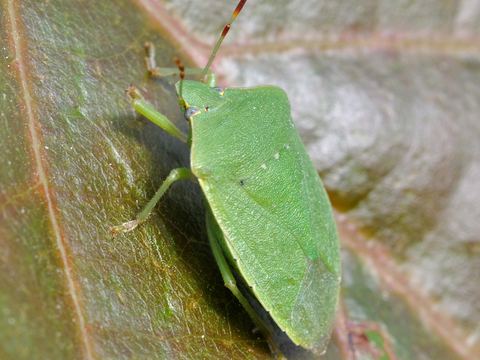
| Colour | Mottled brown | Uniform mid brown, fine dark dots | Usually green, sometimes yellow, orange or brown |
| Antennae | White bands | No white bands to look for | No white bands to look for |
| What to do | Catch it and report it | Nothing needed | A garden matter |
Is it here?
Not as an established pest, on the latest we could read. GIA, the government and industry biosecurity partnership, said in July 2023 it hadn't established here, though it has been caught at the border many times. On 21 September 2026, KVH said New Zealand remained clear of it, with vigilance still critical.
RNZ reported in April 2026 that an adult male was caught in a trap at Ōrākei in February 2026. No more were detected, and a Biosecurity New Zealand manager called it an outlier.
Why does anyone care?
Scale. GIA says it feeds on more than 300 plant species, and could affect fruit and vegetables, native forests and home gardeners if it settled in. It also shelters indoors, which is why a homeowner may be the first to see one.
When's one most likely to turn up?
RNZ says the high-risk season runs from September until April. KVH said in 2019 that adults look for shelter in houses in autumn and winter, and said in 2022 that winter is when one's most likely to be found in enclosed spaces and indoors.
They travel with us, too. KVH says the bug can hitchhike on cars and shipping containers from Asia, the USA and Europe, and suggests checking overseas parcels and unpacking carefully after a trip.
The stink bugs you probably have
Manaaki Whenua says this family gets its name because they give off a strong smell when handled. The green vegetable bug was found in Northland in 1944 and now lives throughout the North Island and in the warmer parts of the South Island. It shrivels beans and sweet corn kernels, and leaves hard, corky growths on tomatoes and tamarillos.
The brown shield bug came from Australia and feeds on plants, especially developing seeds. The brown soldier bug is native, about 11 to 12 mm long, and it's a predator that goes after caterpillars. Both green vegetable bugs and brown shield bugs overwinter as adults, so finding one in a shed or a curtain fold in winter isn't unusual.
What's worth doing
You can
- Photograph any large brown shield bug and check its antennae.
- Keep a jar handy if you find one indoors.
- Check bags, parcels and imported goods after overseas trips.
- Pick green vegetable bugs off crops by hand, wearing gloves if the smell bothers you.
Leave to a pest business
- Nothing for a brown marmorated stink bug: that report goes to Biosecurity New Zealand.
- A pest business has no role with ordinary shield bugs, unless numbers are unusual.

What we'd do with one on the curtain
Look at the antennae. No white bands, and you can carry it outside and forget about it. If you see white bands or you just aren't sure, pop it in a jar, take a photo and make the call. Nobody at Biosecurity New Zealand will mind a false alarm from a careful person. We won't send a pest business for this one.
Want someone to look at it?
Tell us what you've seen and your postcode, and a local pest business that handles exactly that calls you to talk it through.