If someone is bitten
We couldn't find first aid from Health NZ written for centipede bites, so we won't guess. Ring the National Poisons Centre on 0800 764 766 or Healthline for advice, any time. If the person has trouble breathing or looks very ill, phone 111.
Is it a centipede or a millipede?
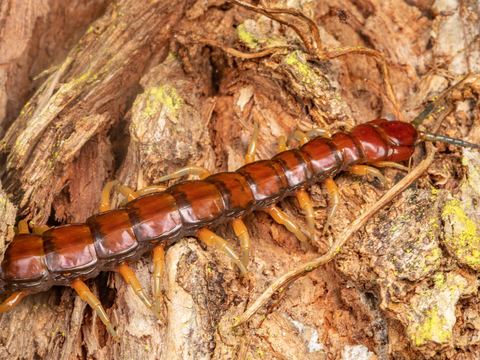
Count the legs on one segment. Te Papa says most body segments carry a pair of legs, or two pairs on a millipede. A centipede's legs stick out to the sides and it runs. A millipede's sit underneath, and it plods.
The name is misleading too. Te Papa says no centipede species has ever been found with exactly 100 legs.
Centipede or millipede?
| Centipede | Millipede | |
|---|---|---|
| Legs per segment | One pair | Two pairs |
| Body | Flat | Rounded |
| Speed | Fast | Slow |
| Food | A hunter of insects and spiders | Mostly rotting plant material |
| Bite | Can bite, with venom | Doesn't hunt, so no venom to worry about |
What is New Zealand's giant centipede?
Te Papa writes about one species that grows up to 25 cm, is widespread in the North Island, and is large, fast and venomous. On the Poor Knights Islands it was seen hunting large insects and lizards at night.
Most you'll meet in a garden are far smaller. Size is still the reason to keep your hands off, because Te Papa says centipedes use a pair of pincer-like limbs to inject their prey with venom.
Why is there one in your house?
It's probably lost, or after food. Centipedes live in damp leaf litter, under rocks and logs and in compost, and they sometimes come indoors after rain. One in the laundry or the bath usually means it wandered in through a gap at ground level.
They're hunters and don't breed in numbers around a house the way some pests do. If you keep finding them, the question is what's damp or sheltered near your walls.
Is it a job for a pest business?
Rarely. One centipede isn't worth anyone's call-out. Regular sightings are more about damp under the floor or heavy garden litter against the house, and a general treatment does little if that doesn't change. It might be worth asking if you're seeing them weekly and can't work out why.
What keeps them out
You can
- Move compost, logs and leaf piles away from the walls.
- Keep the subfloor dry and aired.
- Seal gaps at the bottom of doors and around pipes.
- Wear gloves when you lift pots, logs or firewood.
- Pop a jar over one and slide card under it to move it, rather than using your hand.
Leave to a pest business
- Checking for damp spots under the house.
- A general treatment, if sightings stay frequent.

What we'd do about centipedes
We'd put a jar over it, slide some card underneath, and walk it to the far end of the garden. If you're finding them often, fix the damp first. Only then would we pay for a visit. Tap Not sure what it is if you'd like someone to look.
Want someone to look at it?
Tell us what you've seen and your postcode, and a local pest business that handles exactly that calls you to talk it through.