If someone's been stung
Get everyone inside and keep pets away from the nest. Health NZ says to wash a sting with soap and cold water, then hold an ice pack on it for 15 minutes. Swelling of the face or throat, wheezing or trouble breathing after a sting means 111, straight away. For first aid, ring the National Poisons Centre: 0800 764 766.
What's different in Auckland
Nests that outlast the winter
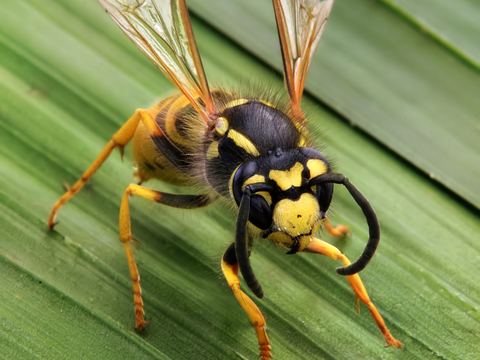
DOC says German and common wasp colonies can become huge if they survive the winter, and NIWA says many parts of the Auckland region get only a few frosts each year. An Auckland Council ecologist told RNZ in 2020 that a very large nest could survive winter, and its queens could found satellite nests in spring.
The Karekare nest
In 2020 RNZ reported a common wasp nest of roughly 1 m by 2 m by 2.5 m, hanging high in a tree near Karekare in the Waitākere Ranges Regional Park. It's thought to have grown for up to two years. The council said it would have brought in a specialist if a storm hadn't brought the nest down first.
On the regional pest plan
Auckland Council lists German and common wasps for sustained control across the whole region, and the plan bars anyone from breeding, releasing or selling them. The aim is to slow their spread and the harm they do. It isn't a nest removal service.
Your section or a reserve
Friends of Le Roys Bush, a volunteer group on the North Shore, says council staff can't deal with wasps on private property, so the owner or tenant brings in a contractor. A nest in a council reserve is different: the group says to ring the council with its exact location.
Paper wasps under the eaves
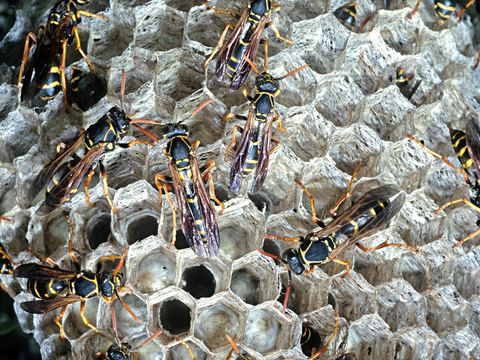
Auckland has both kinds of paper wasp. Asian paper wasps are 13 to 25 mm, yellow and black with tan legs, and Australian paper wasps are 10 to 15 mm and reddish brown. Both hang an open comb you can see, usually under eaves or from branches.
What makes a nest job bigger or smaller
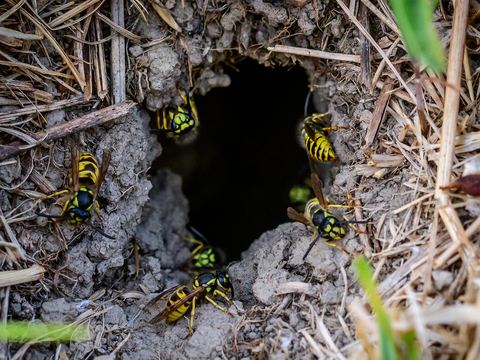
Where it sits matters most. A hole in open lawn is the simpler job; a nest inside a wall, a ceiling space or high in a tree takes more getting at. Steep sections, retaining walls and thick bush edges, all common in Auckland, add time.
Age matters too. A University of Auckland professor named January to February as the time to deal with a colony, and said in March 2025 that larger, older nests were especially dangerous. A nest found in autumn is often bigger than its entrance hole suggests.
Have these ready when the pest business rings
- Where the wasps go in and out, worked out from well back.
- Whether the nest is on your section, a neighbour's, or in a reserve.
- Who at home has reacted badly to a sting before.
- How a technician gets to it: the gate, the dog, the slope, how high it is.
While you wait
You can
- Keep doors and windows on the nest side shut.
- Cover meat and scraps outside: DOC says wasps go after protein in the warmer months.
- Put a chair or tape across the path so visitors keep away.
- Let the neighbours know if the nest is near the fence.
Leave to a pest business
- Treating any nest, in the ground, a wall, a ceiling or a tree.
- Anything that needs a ladder.
- Nests beside doors, decks or where children play.
Before they start
- What product will you use, and can I see its safety data sheet?
- How long should people and pets keep away afterwards?
- Will the nest be left in place or taken away once the colony is dead?
- What if there's still traffic at the entrance in a few days?

Our take on wasp nest removal in Auckland
A nest by the back door goes first on our list. We'd get everyone inside, find the entrance from a long way back, and send a photo with where it is. No fly spray, no hose, no fire: a disturbed colony is how people end up stung several times at once.
Want someone to look at it?
Tell us what you've seen and your postcode, and a local pest business that handles exactly that calls you to talk it through.